WatchPAT ONE Home Sleep Test
What is it?
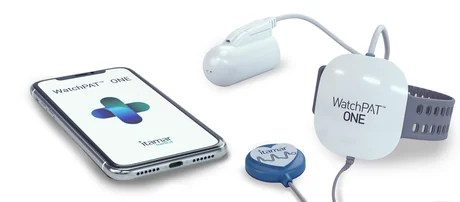
The WatchPAT ONE is a small, single-use wearable device designed to help your healthcare provider assess if you have sleep-related breathing problems, all from the comfort of your own bed. This non-invasive device is worn on your wrist and uses a soft probe slipped onto your non-dominant finger. The data collected during the night is automatically sent through a mobile application on your phone to a secure storage location for professional analysis.
How is it different from regular WatchPAT?
The key feature of the WatchPAT ONE is that it is fully disposable and intended for single use. Unlike many reusable testing systems, this means there is no equipment cleaning, charging, or complicated return shipment process necessary once the one-night study is complete.
What does it test for?
The test aids in the diagnosis of sleep-related breathing disorders, identifying both obstructive and central breathing disturbances. It records several crucial signals, including the pulse in your fingertip (the PAT™ signal), your oxygen levels, and your physical movement. It also provides estimates of your sleep stages—specifically, Light Sleep, Deep Sleep, Rapid Eye Movement (REM) Sleep, and Wakefulness. If the device includes a chest sensor, it also captures your snoring level and body position throughout the night.
How is the test conducted?
You start by inserting a new AAA Alkaline battery into the device and installing the proprietary mobile application on your phone. You strap the wrist unit onto your non-dominant arm and place the probe snugly on one finger. If applicable, the chest sensor is attached to the center of your upper chest bone, below the front of your neck. You must keep your mobile phone charging and nearby (within five meters) all night. When you are ready for bed, you press the "Start recording" button on the app. In the morning, you press "Stop recording," and the data is automatically transferred and uploaded.
How will the data be useful to the doctor?
The detailed analysis derived from this study significantly helps your doctor make an accurate diagnosis. Because the test estimates sleep stages, it calculates indices reflecting pauses in breathing based on your True Sleep Time (the time you were actually asleep), avoiding the inaccuracies associated with using total recording time. The data also assists in determining if breathing issues are triggered when sleeping on your back (positional sleep apnea). Additionally, the system flags potential signs of heart rhythm irregularities (cardiac arrhythmia detection), which serves as supplemental information for the physician to decide if further heart examinations are needed.
Interested in this service or want to know if it's right for you?